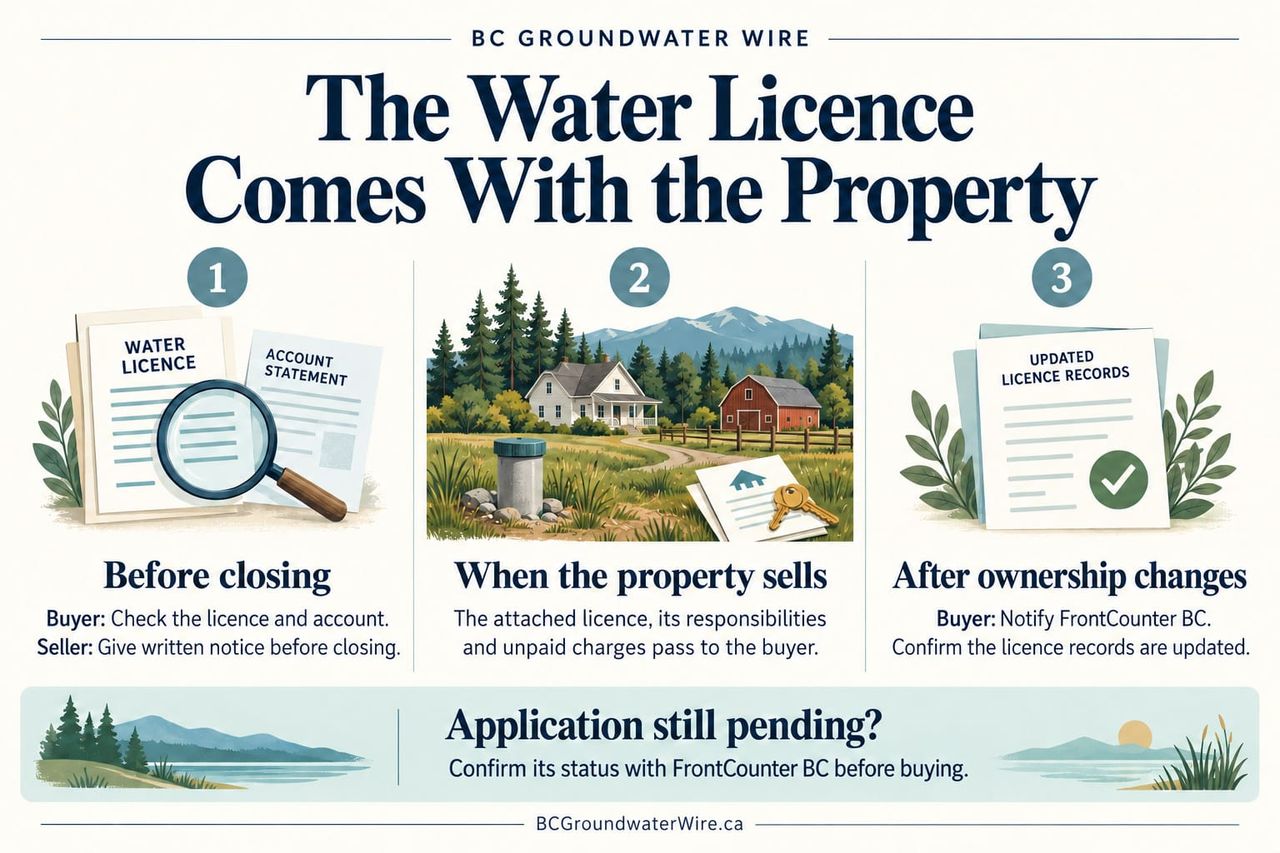
Yes. In British Columbia, a water licence registered to a property transfers to the new owner when the property is sold. The purchaser takes on the responsibilities of the licence holder, including responsibility for outstanding licence charges. Check the account before you buy.
Ask for the licence and the bill. Request a copy of the water licence and a recent account statement showing annual charges and any outstanding balance. Have your lawyer or notary address who will pay those charges as part of the sale. The Province’s name-change guidance specifically warns buyers that unpaid rentals, amendment fees, late-payment fees, and other balances become the new owner’s responsibility.
Make sure the Province is notified. Registering the property sale does not automatically update the water-licensing records. Until those records change, invoices go to the licence holder still on file.
The seller must provide written notice to the comptroller or a water manager before completing the sale (Water Sustainability Act, section 25). The licence holder must also notify the water manager or the comptroller when the land is subdivided. Once ownership records have changed, the buyer must notify FrontCounter BC to update the licence holder information. There is no fee for that notification. The Province explains that changing the name on a licence is not considered an amendment.
Check which land the licence covers. Confirm that the property you are buying is the land identified on the licence. If the land has been subdivided, ask FrontCounter BC whether the water rights need to be apportioned between parcels. A simple name change may not be enough.
If the application is still pending, please review the file. Ask the seller for the application, submission confirmation, file number, and recent correspondence. Before committing to the purchase, ask FrontCounter BC to confirm the application’s status and what you must do when ownership changes. A file number alone does not establish that a licence has been issued.
The Note: Do not rely on a title search alone. Check the water licence and its account separately, while there is still time to resolve questions before the sale. The Province’s Water Rights Databases page provides access to the Water Licence Search Tool and BC Water Resources Atlas to help you investigate.
Who should pay attention: Buyers and sellers of BC farms, acreages, and rural businesses with licensed water supplies, and their lawyers, notaries, realtors, and lenders.
What to do next: Sellers should provide the licence, current account information, and any pending application records and arrange the required notice before closing. Buyers should have those records reviewed before removing purchase conditions, agree on how outstanding charges will be paid, and confirm afterward that FrontCounter BC has recorded the ownership change.
Checked against: Province of BC, Buying or Selling Property That Has a Water Well, updated April 4, 2019; Frequently Asked Questions About Water Billing, updated November 12, 2025; Rights and Obligations of Water Authorization Holders, July 2024; Amend or Abandon a Water Licence, updated November 12, 2025; Change the Name on a Water Licence, updated November 12, 2025; Submit notice of water licence name change, address change or licence transfer; Water Rights Databases, updated June 15, 2021 · checked October 17, 2026
Updates: October 16, 2026 · Corrected: before completing the sale, the seller must give written notice to the comptroller or a water manager, as section 25 of the Water Sustainability Act requires; the post now cites the section. An earlier version said only that the licence holder must notify the water manager or the comptroller when the land is sold or subdivided.
Related on the Wire: The Bank Is Now the Enforcement Arm for BC Groundwater Licences; Deadline Passes for Existing BC Groundwater Users