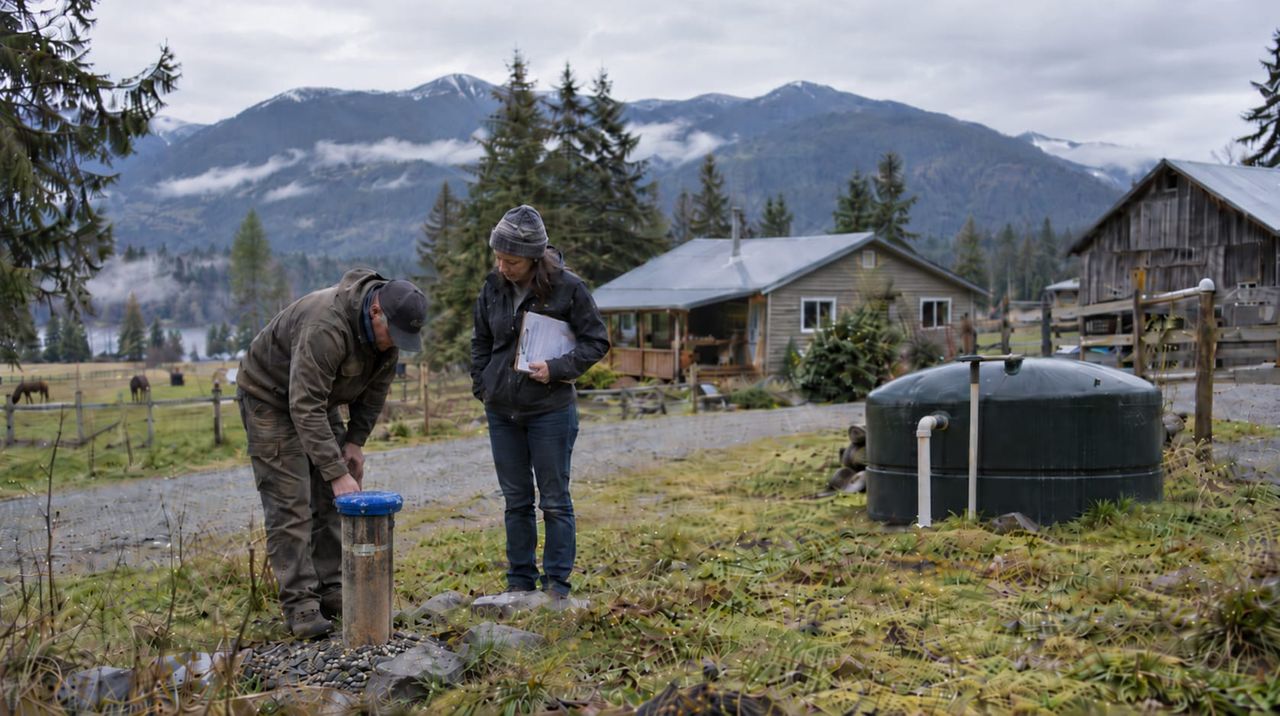
Find out how the property is serviced with water, whether it has a well, what it is like in the dry season, and what the water tests show. Request the water well records before you commit and likely have the system inspected. A neighbour’s productive well, a nearby lake, or good pressure at the kitchen tap do not constitute a reliable water supply for a rural property in British Columbia.
Identify the source and the well. Get the well record and confirm it belongs to the well serving the property. Ask about other wells, including any that were closed. The Province’s guidance for sales names the well record, water quality results, and pumping or flow test results as what a seller should disclose.
Examine dry-season performance. Ask for dated pumping tests, water level records, and any history of shortages or hauled water. Examine the pumping rate, how long the test ran, how far the level fell, and how it recovered. The yield on a well record may come from a short test; it is not a pumping test.
Review bacteria and chemistry. Ask for recent laboratory reports and whether the sample was untreated water or taken after treatment. A clean bacteria result says nothing about arsenic, nitrate, or other chemistry.
Match the supply to your plans. Household use does not show capacity for commercial irrigation, a livestock operation, or a business. Groundwater for domestic use needs no licence; non-domestic uses generally need a BC groundwater licence. A well record is not a licence. If a licence is attached to the property, get it and the latest rental invoice: the Province says unpaid amounts transfer to the new owner.
Sort out shared arrangements. For a shared or off-property supply, have your conveyancing professional review access, maintenance, and cost sharing.
Have they been bringing water on the property? Large storage tanks often indicate that storage capacity is needed, especially if the well goes dry in the hot summer months.
The Note: Ask what the evidence establishes for your intended use. Missing records are a reason to investigate and test.
Who should pay attention: Rural property buyers, sellers, realtors, conveyancing lawyers, and lenders.
What to do next: Obtain the records while there is still time to investigate. Use a registered well driller or pump installer for the physical system and your conveyancing professional for access and licence questions.
Checked against: Buying or Selling Property That Has a Water Well, Change the Name on a Water Licence, and HealthLink BC: Well Water Testing · checked October 11, 2026
Related on the Wire: Nearby Water Well Records in BC Are Clues, Not Guarantees; Do I Actually Need a Groundwater Licence in BC?; Does a Water Licence Transfer When a BC Property Is Sold?